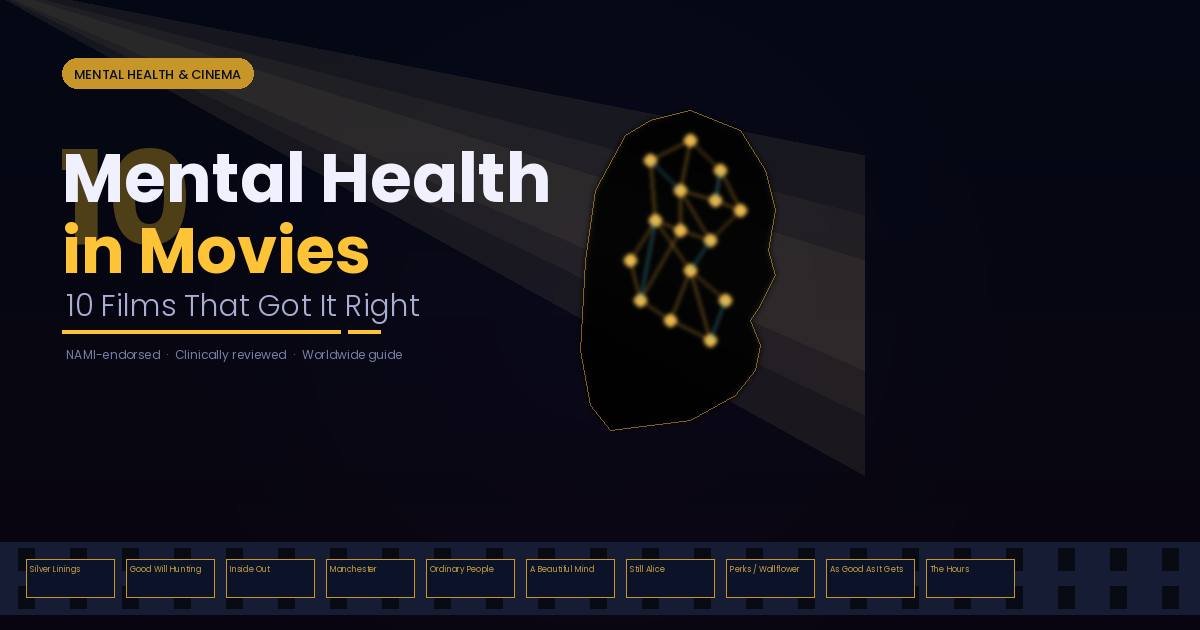
Mental Health in Movies: 10 Films That Got It Right
Hollywood has a complicated relationship with mental illness. Most films either romanticize it, weaponize it for shock value, or flatten it into a single tired trope — the dangerous psychopath, the magical manic pixie, the tortured genius who’s brilliant because of his disorder.
The research backs this up. A 2020 study in JAMA Network Open found that nearly two-thirds of films depicting mental illness portray those characters as violent — a rate wildly inconsistent with clinical reality.
But a handful of films have done it differently. These ten movies tackled depression, trauma, bipolar disorder, schizophrenia, and OCD with honesty, nuance, and — perhaps most importantly — without reducing their characters to their diagnosis. This list breaks down exactly what each film got right, why mental health professionals endorse them, and what any viewer can learn from watching them.
Why Mental Health Portrayal in Film Actually Matters
The way mental illness appears on screen directly shapes how millions of people understand it in real life. A 2019 study published in Psychiatric Services found that media exposure is one of the strongest predictors of public attitudes toward people with mental health conditions — stronger than personal contact in some population groups.
That influence cuts both ways. Films that rely on lazy clichés — the violent schizophrenic, the manipulative borderline, the “crazy” ex — actively reinforce stigma. According to the National Alliance on Mental Illness (NAMI), 1 in 5 adults in the United States experiences a mental health condition each year. Yet the gap between what cinema depicts and what those individuals actually experience remains enormous.
Stigma has real consequences. Research published in World Psychiatry links mental health stigma to treatment delays, social isolation, and poorer health outcomes. People who internalize stigmatizing portrayals — including those about their own condition — are less likely to seek help.
The ten films in this article close that gap, or at least narrow it. They were selected based on endorsements from mental health professionals, clinical psychologist input in published interviews, and accuracy in depicting symptoms, treatment, and recovery as described in current clinical literature.
What Separates Accurate Portrayals from Harmful Ones
An accurate mental health portrayal meets four standards: it depicts symptoms correctly without exaggeration; it shows the full human being, not just the diagnosis; it avoids using mental illness as a plot device for violence or comedy; and it represents treatment — therapy, medication, peer support — with some degree of realism.
Most films people associate with “mental health movies” — Psycho, Black Swan, Joker — fail at least three of these criteria. They use psychiatric conditions to create menace, titillation, or spectacle. The films below do something harder: they make you feel what it is like to live inside a mind that works differently, without turning that experience into entertainment at the character’s expense.
The 10 Mental Health Movies That Got It Right
1. Silver Linings Playbook (2012) — Bipolar Disorder
Condition depicted: Bipolar I Disorder, OCD traits Director: David O. Russell
Pat Solitano (Bradley Cooper) returns home after eight months in a psychiatric facility following a violent episode triggered by finding his wife in the shower with another man. He has bipolar disorder. He is also charming, self-aware in bursts, and profoundly difficult to love.
What Russell gets exactly right is the texture of bipolar disorder between episodes: the racing optimism, the refusal of medication, the cognitive distortions that feel completely rational from inside them. Pat isn’t unhinged — he is a person struggling with a condition that makes self-regulation genuinely difficult, not a matter of willpower or character strength.
NAMI named Silver Linings Playbook its top pick for accurate mental health portrayal the year of its release. The film’s honest depiction of medication non-compliance is particularly precise — a major challenge in real bipolar treatment. Pat doesn’t avoid his pills because he’s reckless. He avoids them because they blunt the sharpness he has come to identify with himself.
Jennifer Lawrence’s Tiffany, dealing with depression and impulsive behavior after her husband’s death, adds a second, equally grounded portrayal. Two broken people support each other without either being “fixed” by the relationship — which is how recovery actually tends to work.
2. Good Will Hunting (1997) — Complex Trauma and PTSD
Condition depicted: Complex PTSD, Attachment Disorder Director: Gus Van Sant
Will Hunting (Matt Damon) is a mathematical genius from South Boston who has been through the foster care system and survived years of physical abuse. His emotional fortress is impenetrable — until it isn’t.
What elevates this film above its feel-good reputation is its clinical honesty about trauma. Will doesn’t open up because his therapist Sean Maguire (Robin Williams) is kind. He opens up because Sean has experienced real loss and refuses to perform therapeutic professionalism at him. The turning point — the repeated “It’s not your fault” — works not as a magic phrase, but as a moment inside a relationship built slowly over months of resistance.
Therapists regularly cite Good Will Hunting in training discussions as a realistic portrayal of therapeutic alliance and the particular challenge of treating clients with high ACE scores (Adverse Childhood Experiences). The film shows correctly that insight alone doesn’t produce change — the therapeutic relationship does.
3. Inside Out (2015) — Emotional Psychology and Depression
Condition depicted: Emotional dysregulation, childhood depression Director: Pete Docter
Pixar consulted two psychologists — Dr. Dacher Keltner of UC Berkeley and Dr. Paul Ekman, one of the world’s leading researchers on emotion — to ensure the emotional architecture of Inside Out was grounded in science.
The result is one of the most effective emotional education tools ever put on screen. The film’s central insight — that sadness is not the enemy of wellbeing but a necessary signal that something important has been lost — aligns directly with current clinical thinking on emotional processing and the function of negative affect.
When Riley becomes depressed following her family’s move to San Francisco, she doesn’t just feel sad. She goes flat. Joy and sadness both go offline. This blunted affect is characteristic of clinical depression and is rarely depicted this accurately in mainstream film — let alone in a children’s movie.
The 2024 sequel, Inside Out 2, extends this by adding anxiety and the complexity of adolescent identity formation, with additional clinical consultants brought in specifically for the teenage mental health content.
4. Manchester by the Sea (2016) — Complicated Grief
Condition depicted: Complicated Grief Disorder, Major Depressive Disorder Director: Kenneth Lonergan
Lee Chandler (Casey Affleck) caused a fire that killed his three children. Years later, he has not forgiven himself. He does not work toward forgiveness over the course of the film. He does not achieve it.
This is what makes Manchester by the Sea genuinely brave as a piece of mental health storytelling. Hollywood grief has an arc — denial, anger, bargaining, acceptance. Real grief, especially grief fused with guilt, doesn’t. Lee ends the film slightly better than he began, but fundamentally the same. He cannot move back to Manchester. He can only make slightly more room in his small apartment for his nephew.
Complicated grief — now formally recognized in the DSM-5-TR as Prolonged Grief Disorder — looks exactly like this: an inability to integrate the loss, chronic emotional numbing, and a life built around systematic avoidance. The film never pathologizes Lee or presents him as broken beyond care. It simply shows what living inside that state looks like, day by day.
5. Ordinary People (1980) — PTSD and Family Therapy
Condition depicted: PTSD, Survivor’s Guilt, Suicidal Ideation, Family Systems Director: Robert Redford
Conrad (Timothy Hutton) survived a boating accident that killed his brother. He subsequently attempted suicide. He’s now in outpatient therapy with Dr. Berger (Judd Hirsch). His mother (Mary Tyler Moore) has sealed the family home against any acknowledgment of grief.
Forty-five years after its release, Ordinary People remains one of the most psychologically precise films in this genre. Dr. Berger’s approach — confronting avoidance directly, probing for authentic emotion, refusing to let Conrad hide behind social performance — closely mirrors what we now recognize as trauma-focused cognitive behavioral therapy.
The film also depicts, with unusual accuracy, how trauma affects families as systems. Conrad’s mother is not simply cold — she is a person whose coping mechanism (emotional suppression) is directly incompatible with her surviving son’s need to express and process grief. These are two people using the only tools they have. The tragedy is that their tools are mutually destructive.
Ordinary People won four Academy Awards including Best Picture and Best Director. It earned both.
6. A Beautiful Mind (2001) — Schizophrenia
Condition depicted: Paranoid Schizophrenia Director: Ron Howard
John Nash (Russell Crowe) is a mathematical genius who develops paranoid schizophrenia and spends decades in a battle with delusional thinking before eventually being awarded the Nobel Prize in Economics in 1994.
The film’s most significant contribution to mental health representation is its decision to show Nash’s delusions from the inside — as completely real experiences with full sensory detail and emotional weight. Viewers understand viscerally why Nash cannot simply “snap out of it.” The hallucinations are not horror-movie monsters. They are people Nash trusts, admires, and loves.
Where clinical professionals have noted inaccuracy is in the implication that Nash managed his condition largely without medication through sheer willpower. The real John Nash did take antipsychotics, with complicated feelings about their effects. For a film that otherwise humanizes schizophrenia powerfully, this is the notable caveat — though it does not erase the film’s larger achievement.
7. Still Alice (2014) — Early-Onset Alzheimer’s
Condition depicted: Early-Onset Alzheimer’s Disease Directors: Richard Glatzer & Wash Westmoreland
Alice Howland (Julianne Moore) is a linguistics professor who begins losing her language. She is fifty years old.
The Alzheimer’s Association called Still Alice one of the most accurate portrayals of early-onset Alzheimer’s in film history. What it gets precisely right is the patient’s perspective: the terror of noticing gaps before others do, the rehearsed strategies for concealment, the way identity begins to dissolve before the person is actually gone.
Moore’s performance is rendered internally — in small, quiet details, not dramatic breakdowns. She pauses a fraction too long. She takes a longer route she knows by heart rather than a shorter one that’s new. These behavioral details are clinically precise and more unsettling for their quietness. The film also handles the family’s experience with similar care: no one in Alice’s household is the villain; they are all doing something inadequate in response to something impossible.
8. The Perks of Being a Wallflower (2012) — PTSD and Trauma
Condition depicted: PTSD, Childhood Sexual Abuse Trauma, Depression Director: Stephen Chbosky
Charlie (Logan Lerman) narrates his freshman year of high school through letters to an unnamed friend. He is sensitive, observant, and clearly carrying something heavy. The film withholds exactly what happened to him until its final act — and handles the reveal with a care that is genuinely rare in mainstream cinema.
What Perks captures accurately is dissociation and trauma repression: Charlie checks out during moments of intimacy. He freezes. He doesn’t understand why. This is how trauma often presents in adolescents — not as obvious crisis, but as unexplained gaps in presence, sudden emotional absence, and disconnection from the body.
The film also depicts the protective function of peer belonging in trauma recovery, which aligns with current research emphasizing social connection as a key factor in post-traumatic resilience. The relationship between Charlie, Sam, and Patrick isn’t a cure. But it is the container in which Charlie becomes safe enough to begin falling apart.
9. As Good as It Gets (1997) — OCD
Condition depicted: Obsessive-Compulsive Disorder Director: James L. Brooks
Melvin Udall (Jack Nicholson) locks his door five times. He brings his own plastic cutlery to the restaurant. He steps around every crack in the sidewalk. He is also, beneath all of it, capable of genuine love — buried under a disorder that has stripped his life of spontaneity and cost him almost every relationship he’s ever had.
The International OCD Foundation has cited As Good as It Gets as one of the more accurate mainstream depictions of OCD — specifically in its portrayal of how intrusive thoughts drive compulsive behavior. Melvin’s rituals are not quirks or eccentricities. They are exhausting, non-negotiable responses to anxiety that climbs unbearably if the rituals are interrupted.
The film risks framing OCD as a personality trait that love can soften — and partially falls into that trap. But Melvin’s disorder does not disappear by the final frame. He manages it incrementally, with motivation, which is closer to what clinical progress actually looks like than a clean resolution.
10. The Hours (2002) — Depression and Suicidal Ideation
Condition depicted: Major Depressive Disorder, Suicidal Ideation Director: Stephen Daldry
Three women. Three time periods. One novel — Mrs. Dalloway — and one shared condition: depression that makes ordinary life feel like moving through water.
Nicole Kidman’s Virginia Woolf is drawn from biographical record — Woolf’s letters and published diaries document her depressive episodes with clinical precision, and the film honors that record. The Hours depicts depression not as sadness but as psychic exhaustion — performing a single normal morning requires an effort invisible to everyone watching.
The film handles Woolf’s suicide with restraint. It is not shown. It is not romanticized. It is not presented as liberation or escape. It is shown as the tragic end of a life that, despite extraordinary suffering, produced extraordinary work. That balance is genuinely difficult to strike, and the film strikes it without flinching.
All 10 Films at a Glance
| Film | Year | Condition Depicted | Notable Endorsement |
|---|---|---|---|
| Silver Linings Playbook | 2012 | Bipolar I Disorder | NAMI Top Pick |
| Good Will Hunting | 1997 | Complex PTSD, Attachment Disorder | Widely cited in clinical training |
| Inside Out | 2015 | Emotional dysregulation, Depression | Dr. Keltner & Dr. Ekman consultants |
| Manchester by the Sea | 2016 | Complicated Grief, MDD | Aligns with DSM-5-TR criteria |
| Ordinary People | 1980 | PTSD, Survivor’s Guilt | Best Picture; used in therapy education |
| A Beautiful Mind | 2001 | Paranoid Schizophrenia | Praised for humanizing schizophrenia |
| Still Alice | 2014 | Early-Onset Alzheimer’s | Alzheimer’s Association endorsed |
| The Perks of Being a Wallflower | 2012 | PTSD, Childhood Trauma | Cited for adolescent trauma accuracy |
| As Good as It Gets | 1997 | OCD | International OCD Foundation cited |
| The Hours | 2002 | Major Depression, Suicidal Ideation | Praised for non-romanticized portrayal |
What These Films Teach Us That Textbooks Cannot
The most important thing these ten films share is not just clinical accuracy — it is perspective. They don’t explain mental illness from the outside, the way a diagnostic manual or a documentary might. They render it from the inside, in real time, so that the viewer experiences at least a fragment of what it feels like rather than simply understanding it.
Three lessons run through all of them consistently.
Recovery is not linear. None of these films ends with the central character cured. They end with someone slightly better equipped to carry what they carry. That is what progress looks like in real mental health treatment — not resolution, but capacity.
Relationships are both the wound and the medicine. From Will Hunting’s terror of abandonment to Lee Chandler’s frozen grief to Conrad’s suffocating family dynamic, these films understand that mental health does not exist in isolation. Trauma happens in relationships. So does healing.
Diagnosis is a starting point, not an identity. Pat Solitano is not “the bipolar character.” Alice Howland is not “the Alzheimer’s patient.” Charlie is not “the trauma victim.” The films use their conditions to illuminate their characters, not to define them. That is the standard every piece of mental health storytelling should be held to.
Frequently Asked Questions About Mental Health in Movies
Which films are most accurate about depression?
Manchester by the Sea and The Hours are most consistently cited by mental health professionals as accurate portrayals of major depressive disorder. Both depict depression as emotional numbing and exhaustion rather than simple sadness — which aligns precisely with clinical descriptions. For younger audiences, Inside Out remains the most effective and age-appropriate portrayal of emotional health and low mood.
Is Joker (2019) an accurate portrayal of mental illness?
Most mental health professionals consider Joker both inaccurate and potentially harmful. The film directly links untreated mental illness to mass violence — a connection that contradicts decades of research. Studies consistently show that people with mental illness are significantly more likely to be victims of violence than perpetrators. NAMI publicly criticized the film’s portrayal, and several clinical organizations issued statements of concern before its release.
What movies are best for learning about OCD?
As Good as It Gets (1997) is the most widely cited mainstream film for OCD representation. For younger audiences or a more clinical portrayal, the documentary Unstuck: An OCD Kids Movie (2017) is frequently recommended by therapists working with children and families. The OCD portrayals in The Aviator (2004), depicting Howard Hughes, are also noted by clinicians for their accuracy.
Can watching mental health movies actually help people?
Research on “cinema therapy” suggests that films can be useful therapeutic tools when used in clinical contexts — helping clients externalize and examine their own experiences through the lens of a fictional character. A 2019 study in Arts in Psychotherapy found that film-based discussions increased emotional awareness and reduced shame around mental health. This works best as a supplement to professional care, not a substitute for it.
Which film depicts therapy most realistically?
Ordinary People (1980) and Good Will Hunting (1997) are most frequently cited by therapists as accurate depictions of the therapeutic process — including resistance, therapeutic rupture, breakthrough, and the primacy of the therapeutic relationship over technique. Both show therapy as slow, nonlinear, and sometimes emotionally brutal. Neither shows it as a quick fix.
Are there good mental health films specifically for teenagers?
The Perks of Being a Wallflower is widely recommended for adolescent audiences for its accurate portrayal of trauma and PTSD. Inside Out and Inside Out 2 are appropriate for younger viewers and are used in school settings to discuss emotional health and anxiety. Eighth Grade (2018), while not exclusively about clinical mental health, depicts social anxiety in adolescence with considerable honesty.
Why is Black Swan not on this list?
Black Swan depicts what appears to be psychosis and severe body image disturbance — but uses both as horror elements rather than psychological realities. The International OCD Foundation and multiple clinical voices have noted that the film misrepresents the subjective experience of these conditions in ways that could amplify stigma. Portrayals that use mental illness as a vehicle for dread fall outside the criteria for this list, regardless of their craft.
Conclusion
Mental health in movies has come a long way — and it still has a long way to go. The ten films on this list represent what becomes possible when filmmakers approach the subject with genuine care: not as spectacle, not as a shorthand for danger or genius, but as an honest attempt to understand what it means to live inside a mind that hurts.
These films won’t replace therapy. But they can do something therapy can’t always do in its early sessions: they can make someone feel less alone before they’re ready to ask for help. That matters more than any clinical accuracy metric.
If any of these films resonate with something you’re personally experiencing, consider reaching out to a mental health professional. NAMI’s helpline is available at 1-800-950-NAMI (6264) if you need to talk to someone today.
The films on this list exist because someone decided the truth was worth telling. So does help.
Looking for answers? Find expert advice in our handpicked articles