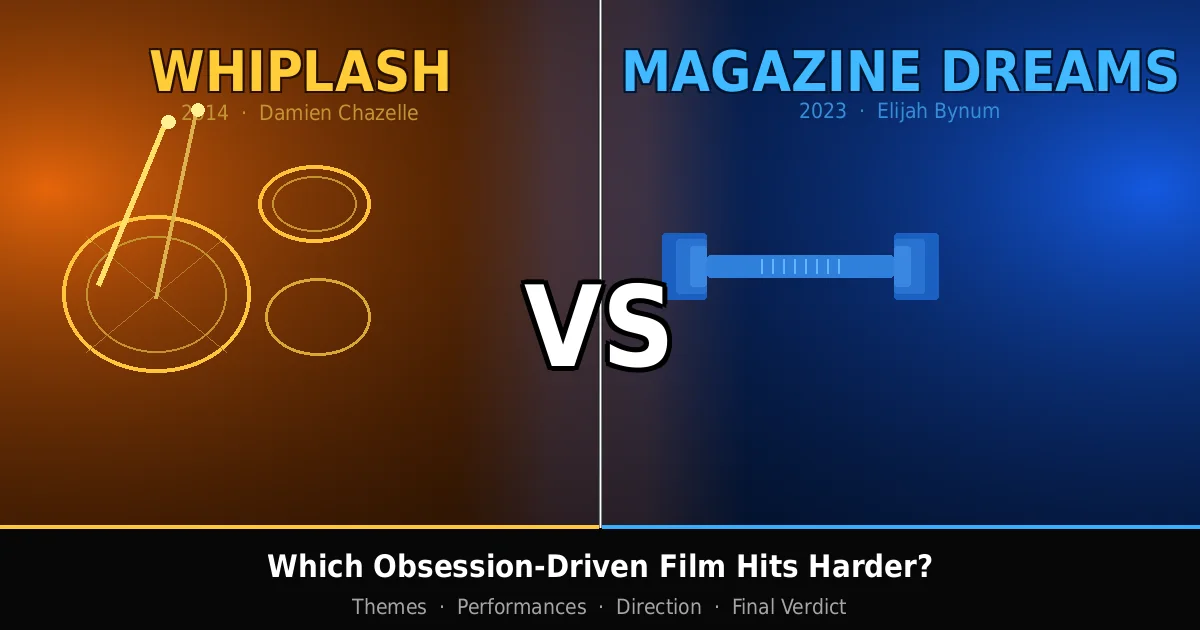
Whiplash vs Magazine Dreams: The Ultimate Expert Comparison
Both films are about men who will destroy themselves to be the best. That shared DNA makes comparing Whiplash and Magazine Dreams one of the most revealing exercises in modern cinema — two obsession portraits, made nearly a decade apart, that mirror and contradict each other in equal measure.
Whiplash (2014) became a cultural phenomenon. Magazine Dreams (2023) became a cautionary tale — not just on screen, but in real life. Together, they form a strange, uncomfortable pair worth examining closely.
This article breaks down both films side-by-side: themes, performances, craft, and the harder question — which one is actually the better film, and why? After rewatching both back-to-back, the answer is more nuanced than either film’s reputation suggests.
What Are Whiplash and Magazine Dreams Actually About?
Whiplash and Magazine Dreams are both psychological dramas about obsessive men in competitive fields — but they use that premise to tell fundamentally different stories. One is a pressure-cooker thriller with a clear antagonist. The other is an internal character study with no villain except the protagonist’s own mind.
Whiplash follows Andrew Neiman (Miles Teller), a 19-year-old jazz drummer at a prestigious New York conservatory who falls under the tyrannical instruction of Terence Fletcher (J.K. Simmons). Fletcher’s method is psychological warfare — screaming, humiliation, and the constant threat of removal. Andrew’s obsessive pursuit of greatness costs him his relationship, his physical health, and very nearly his sanity.
Director Damien Chazelle made the film for approximately $3.3 million, expanding it from a short film he’d shot the year before. It grossed nearly $49 million worldwide, won three Academy Awards — Best Supporting Actor for Simmons, Best Film Editing, and Best Sound Mixing — and received nominations for Best Picture and Best Adapted Screenplay.
Magazine Dreams follows Killian Maddox (Jonathan Majors), a competitive amateur bodybuilder in small-town America whose obsession with his physique masks a deeper crisis: mental illness, loneliness, and a desperate need for external validation. Unlike Whiplash, there is no Fletcher figure to externalize the conflict. Killian is fighting himself — his own distorted self-image and a fragmented psychology that pushes everyone around him away.
Directed by Elijah Bynum, the film premiered at the Sundance Film Festival in January 2023 to strong reviews, particularly for Majors’ physically and emotionally transformative performance. Searchlight Pictures acquired it for wide release. That release never fully arrived. In December 2023, Majors was convicted of assault. Searchlight shelved the theatrical rollout, and the film eventually arrived on Hulu in early 2024 — largely robbed of the cultural moment it had earned.
How Do Whiplash and Magazine Dreams Compare on Theme?
Both films are fundamentally about the cost of obsession — but they diagnose that cost very differently. Whiplash frames obsession as a negotiation with greatness. Magazine Dreams frames it as a symptom of illness. That difference in framing shapes every scene, every performance choice, and every emotional beat.
Whiplash suggests that the right kind of suffering might unlock genius. Fletcher believes this completely. The film leaves open whether he is right. Andrew’s final performance is electrifying — but he has also become someone colder, more ruthless, and more alone. Chazelle presents the deal without fully endorsing it, and that moral ambiguity is precisely what makes the film so uncomfortable and compelling a decade later.
Magazine Dreams does not negotiate. It shows obsession as illness without redemption arc. Killian doesn’t have a Fletcher; he has a fractured inner world, a grandfather he barely connects with, and a fantasy life built entirely around fitness magazines. His relationship with his body functions as self-harm wearing the costume of self-improvement.
Where Whiplash asks: “What does greatness cost?” — Magazine Dreams asks: “What happens when someone pursues greatness without the talent infrastructure or psychological stability to reach it?”
That is a harder, less cinematic question. It is also more honest about how obsession actually operates for most people.
Mental Health as Theme vs. Subject
Whiplash touches mental health through extreme external pressure and what most psychologists would classify as emotional abuse. Mental health here is a byproduct of a toxic environment. Remove Fletcher, and Andrew might be okay. The film implies that the damage is situational.
Magazine Dreams makes mental illness the entire subject. Killian is clearly experiencing something more structural — delusion, compulsion, emotional dysregulation. He stalks a woman, writes disturbing fan letters to a professional bodybuilder he has never met, and has violent episodes he cannot control or fully recall. The damage is not situational. It is Killian.
One film glamorizes obsession just enough to make you root for it. The other refuses that comfort entirely. Which approach is more responsible filmmaking is a question worth sitting with.
Which Film Has the Stronger Central Performance?
This is the most contested question between the two films — and the answer is not as obvious as Whiplash‘s awards sweep suggests.
J.K. Simmons in Whiplash is a masterclass in controlled menace. Fletcher shifts from charming to vicious within a single sentence, and Simmons calibrates every scene with surgical precision. His Oscar was fully deserved. It is the kind of supporting performance that can define an entire film — the kind actors study for decades.
Miles Teller as Andrew Neiman carries more of the physical and emotional weight than he typically receives credit for. Teller actually plays the drums throughout — training for months before production — and the film reportedly required him to bleed for real during certain takes. In the finale, you believe every second of it. His restraint in the early scenes makes the final explosion land that much harder.
Jonathan Majors in Magazine Dreams is something categorically different: full-body possession. He gained approximately 25 pounds of muscle for the role, adopting a strict bodybuilding regimen throughout production. But the physical transformation is the smallest part of the work. Majors inhabits Killian’s stuttering, uncertain social manner — the way he stiffens in a grocery store aisle, the way his voice breaks when he is trying to function like a normal person — with a specificity that is genuinely frightening.
After watching both films in close succession, I found Majors’ performance in Magazine Dreams to be the more technically daring of the two. Multiple prominent critics who saw it at Sundance called it one of the great screen performances of the decade. Simmons’ work in Whiplash is the more iconic, but Majors’ work is the more uncompromising.
The tragedy of Magazine Dreams is that its lead performance never received its awards season moment. That is a loss for the cultural record.
Whiplash vs Magazine Dreams — Craft, Direction, and Visual Style
Great acting alone does not make a great film. Craft matters enormously, and this is where the two films diverge most clearly.
Editing and Pacing
Whiplash’s editing is a masterpiece. Editor Tom Cross won the Academy Award for Film Editing, and it is entirely earned. The film cuts like jazz itself — syncopated, deliberate, relentless. The final ten-minute drum sequence is among the best-edited scenes in twenty-first-century cinema. It is not action editing. It is emotional architecture, and it builds to a release that few films in recent memory have achieved.
Magazine Dreams works at a different tempo. At 121 minutes against Whiplash‘s 107, it lingers in ways that feel intentional rather than indulgent — most of the time. Some viewers experience the slower pace as depth and texture. Others experience it as sluggishness. The truth is that it occasionally earns the length and occasionally loses it.
Cinematography and Visual Language
Cinematographer Sharone Meir shoots the conservatory in Whiplash as a pressure cooker — close, claustrophobic, with warm amber tones that make the space feel like the inside of a combustion engine. Every frame serves the tension. The camera rarely relaxes.
Magazine Dreams uses a deliberately uglier visual palette: fluorescent gym lights, drab apartment interiors, fast-food parking lots at night. The film refuses beauty. This is a world without glamour, and Bynum’s visual choices reinforce the theme — Killian is chasing a fantasy that the film shows us, quietly but insistently, is built from cardboard.
Direction
Damien Chazelle’s direction in Whiplash is technically tighter. He knows exactly what he wants in every scene and extracts it with confidence. There is not a wasted moment in the film. Every choice has a function.
Elijah Bynum’s direction in Magazine Dreams is more exploratory — which is both braver and less consistent. He gives Majors enormous room to work, and Majors fills it. But a few sequences feel under-shaped in a way that a more controlling directorial hand might have resolved. Bynum is a filmmaker worth watching carefully. He is not yet operating at Chazelle’s level of control.
Whiplash vs Magazine Dreams: Side-by-Side Comparison
| Element | Whiplash (2014) | Magazine Dreams (2023) |
|---|---|---|
| Director | Damien Chazelle | Elijah Bynum |
| Lead Performance | Miles Teller, J.K. Simmons | Jonathan Majors |
| Genre | Drama / Music | Drama / Sports / Psychological |
| Runtime | 107 minutes | 121 minutes |
| Production Budget | ~$3.3 million | Not publicly disclosed |
| Worldwide Box Office | ~$49 million | Streaming release only |
| Academy Award Wins | 3 (Supporting Actor, Editing, Sound Mixing) | None — awards season disrupted |
| Critical Reception | 96% on Rotten Tomatoes | Strong Sundance buzz; mixed wider reception |
| Central Conflict | External — student vs. tyrannical mentor | Internal — self vs. fractured self |
| Tone | Controlled, escalating intensity | Raw, volatile, deliberately uncomfortable |
| Obsession Type | Artistic perfectionism | Body dysmorphia / identity crisis |
| Mental Health Treatment | Environmental / situational | Structural / clinical |
| Ambiguity Level | Moderate (ambiguous triumph) | High (collapse, no resolution) |
| Where to Stream | Multiple platforms (varies by region) | Hulu (US); availability varies elsewhere |
| Cultural Impact | Enormous and lasting | Significant but severely disrupted |
What Are the Most Important Differences Between the Two Films?
The single most important structural difference is this: Whiplash has a clear antagonist. Magazine Dreams does not.
That decision shapes everything. Fletcher gives Whiplash a traditional dramatic engine: opposition, escalation, confrontation, climax. Even in its most formally experimental moments, Chazelle keeps the audience emotionally anchored because we always know where the danger is coming from. Fletcher is the threat. Andrew is the response. The film is propulsive because of that clarity.
Magazine Dreams has no such anchor. Killian’s enemy is inside him, which makes the film more ambitious and simultaneously harder to sustain. Films driven entirely by internal conflict demand extraordinary craft to maintain audience engagement across two hours. Magazine Dreams achieves this in its best scenes. It does not achieve it consistently.
The second crucial difference is how each film handles resolution. Whiplash ends on a moment of ambiguous transcendence — Andrew’s final performance dismantles Fletcher’s composure, and something resembling triumph emerges, even if you are not sure you should be celebrating it. The ambiguity is generative. You leave the cinema arguing about it.
Magazine Dreams ends in deliberate refusal of resolution. It denies catharsis on purpose. Whether that functions as artistic integrity or frustrating restraint depends on what you ask of a film about mental illness. Both readings are defensible.
Common Myths About Whiplash and Magazine Dreams
“Whiplash glorifies abuse.”
This is the most persistent misreading of the film. Chazelle deliberately constructs the ethics as ambiguous — he is not endorsing Fletcher’s methods. The film seduces you into Fletcher’s logic and then asks whether you should have allowed yourself to be seduced. That moral trap is the point. Calling the film a straightforward glorification of abuse misses the self-awareness embedded in its structure.
“Magazine Dreams failed because of Jonathan Majors’ controversies.”
The film did not fail creatively. It was a distribution casualty. The performance, the script, and the direction were all critically validated at Sundance before the controversy developed. What the film lost was its release window and its awards campaign — which is a commercial failure, not an artistic one. The film itself is as strong as it was the day it screened at Sundance.
“Whiplash is just a movie about jazz drumming.”
Music is the vehicle. The film is about the psychology of ambition — how far you are willing to go, and what you are willing to lose getting there. You do not need to know a single thing about jazz to feel every frame. The drumming is the surface. The film lives underneath it.
“Magazine Dreams is too slow to be worth your time.”
If you approach it expecting Whiplash‘s momentum, yes — it will feel slow and unrewarding. If you approach it as a psychological portrait in the tradition of Taxi Driver or The Wrestler, the tempo makes complete sense. It is building a different kind of experience. The slowness is not a failure of craft. It is a deliberate choice about what kind of discomfort the film wants to create.
“The two films are basically the same movie.”
They share thematic DNA, but they are telling opposite stories. Whiplash examines how external pressure shapes inner greatness. Magazine Dreams examines what happens when inner dysfunction destroys someone regardless of their efforts. One film asks whether a system can manufacture genius. The other asks what remains when genius never arrives.
Frequently Asked Questions
Is Whiplash based on a true story? Not directly. Director Damien Chazelle drew on his own experiences as a drummer in a high-pressure music program during high school. The film is not a biopic, and the character of Fletcher is fictional — but the emotional dynamics Chazelle depicts reflect real experiences he witnessed and survived. That personal grounding is part of why the film feels so lived-in.
Where can I watch Magazine Dreams in 2024 and beyond? Magazine Dreams is available to stream on Hulu in the United States. Availability in other regions varies by platform and country. It never received a wide theatrical release following the events of late 2023. Checking your regional streaming services directly is the most reliable way to find it.
Did Jonathan Majors win any awards for Magazine Dreams? Majors’ performance generated significant early award buzz following the Sundance premiere in January 2023, and he was widely discussed as a potential Oscar contender. The film never entered a formal awards campaign following Majors’ legal situation in late 2023, meaning the performance was effectively removed from that year’s conversation. Multiple critics described the omission as one of the more significant losses of that awards cycle.
Which film should a first-time drama viewer watch first? Start with Whiplash. It has a more conventional narrative structure, a shorter runtime, and a momentum that carries even reluctant drama viewers forward. Magazine Dreams rewards patience and is better approached by viewers already comfortable with slower, more psychological filmmaking. Use Whiplash as the gateway and Magazine Dreams as the deeper dive.
Is Magazine Dreams appropriate for viewers sensitive to mental health themes? No, not without awareness. The film deals directly and unflinchingly with mental illness, violent ideation, social isolation, body dysmorphia, and compulsive behavior. It does not treat these subjects carelessly — but it does not soften them for audience comfort either. Viewers who find such themes distressing should approach with full knowledge of the film’s content.
Which film is considered more critically acclaimed overall? Whiplash, by every measurable standard — a 96% Rotten Tomatoes score, three Academy Awards, and a decade of sustained critical reassessment. That said, several prominent critics and filmmakers consider Majors’ performance in Magazine Dreams to be the more remarkable individual acting achievement of the two films. The distinction between “better film” and “better performance” is worth maintaining here.
What is the thematic connection between Whiplash and Magazine Dreams? There is no official creative connection between the two productions. Both films independently explore obsessive male protagonists in competitive fields, the psychological cost of perfectionism, and the question of whether the pursuit of greatness can be separated from the self-destruction it causes. Film critics frequently place them in conversation with each other precisely because their shared themes illuminate each other so clearly.
Final Verdict: Which Film Should You Watch?
Whiplash is the better film. That verdict holds up across nearly every technical and structural measure — tighter screenplay, more controlled direction, iconic performances from two actors at the peak of their craft, and an ending that justifies every frame that precedes it. Its cultural impact has been enormous and lasting. A decade on, it has not dated.
But “better film” is not identical to “more important performance” or “more emotionally honest portrait of obsession.” On those criteria, Magazine Dreams makes strong, uncomfortable claims.
Watch Whiplash first if:
- You want a tightly constructed, propulsive drama that works on its first and fifth viewing
- You are looking for something accessible to general audiences without sacrificing complexity
- You want to understand why it remains a benchmark for psychological filmmaking
Watch Magazine Dreams afterward if:
- You want to see one of the most physically and psychologically committed screen performances of the past decade
- You are interested in films that treat mental illness without romantic framing or redemptive resolution
- You can tolerate — and appreciate — a film that deliberately refuses to give you what you came for
The best approach is to watch both within the same week. Together, they function as a diptych about what ambition does to men when there is no off switch. One film gives you the intoxication of greatness and leaves you questioning whether you enjoyed it too much. The other shows you the wreckage it leaves and refuses to clean it up.
That contrast, sitting between those two films, is where the most interesting conversation about ambition, obsession, and the cost of excellence actually lives.
This article reflects independent editorial analysis. Factual claims regarding box office figures, awards, production budgets, and critical reception are drawn from publicly available industry sources. No sponsorship or promotional relationship exists with any film studio, streaming platform, or production company referenced.
Get ready to discover something—our articles pack valuable lessons for you